
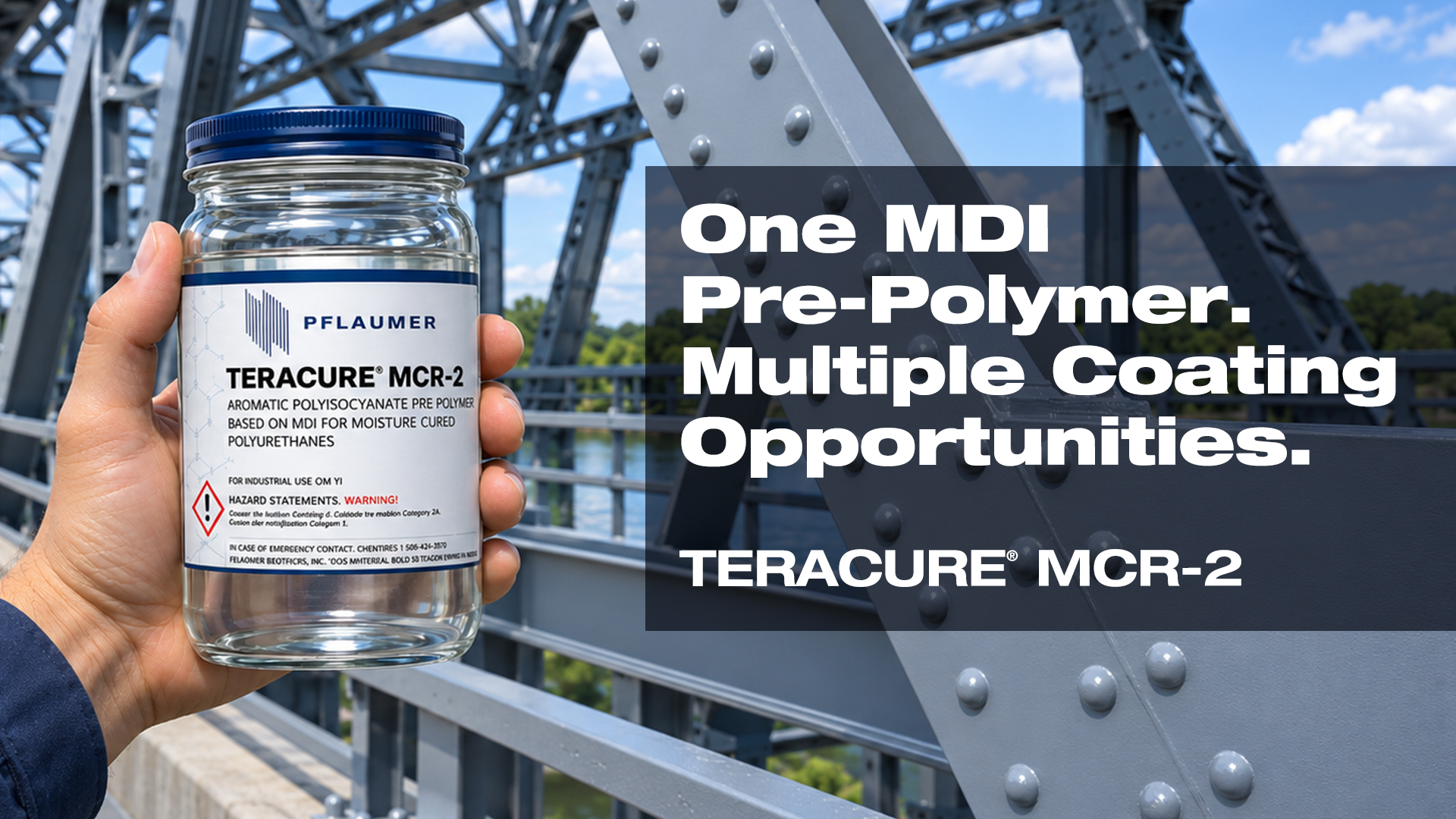
For formulators, an MDI-based polyisocyanate pre-polymer can serve more than one purpose in a coating portfolio. Depending on the formulation, it can function as the reactive foundation for a one-component moisture-cure polyurethane or as the hardener in a two-component system. That versatility makes TERACURE® MCR-2 relevant to a range of protective-coating work, from porous mineral substrates to corrosion-resistant steel primers and polyurethane composites.
Applications identified for TERACURE® MCR-2
Pflaumer’s technical data sheet identifies several uses for MCR-2:
- One-component moisture-cure polyurethane primers and topcoats for masonry and other porous substrates
- Zinc-rich primers for steel, where zinc provides galvanic protection
- Two-component polyurethane coatings, in clear or pigmented formulations
- Polyurethane composite systems, also in clear or pigmented formulations
For zinc-rich primers, it’s advised to test recoat intervals and topcoat compatibility for intercoat adhesion. Pflaumer’s press release also reports that testing indicated improved resistance to mud cracking in zinc-rich primers based on MCR-2. This gives formulators a specific performance characteristic to include in side-by-side replacement work.
A useful profile for protective-coating development
MCR-2 is an aromatic polyisocyanate pre-polymer based on diphenylmethane diisocyanate, or MDI. Its technical data sheet lists approximately 100% solids, 16.5 ± 1.0% NCO, an equivalent weight of 255, and a viscosity of 7,000 ± 2,000 mPa·s at 25°C. These data give formulators a starting point for stoichiometry, viscosity adjustment and application development. Final coating properties depend on the complete formulation.
For solvent borne formulations, compatibility with urethane-grade ketones, aromatic solvents and esters with very low moisture content. The recommended solvent water content is below 0.05%; alcohol solvents should not be used. Those requirements matter when building or replacing a formulation, since moisture and reactive solvent groups can interfere with isocyanate chemistry.
MCR-2’s aromatic MDI chemistry also comes with a design consideration: aromatic polyurethane coatings tend to yellow and lose some gloss under light exposure. Industry guidance commonly places aromatic systems in primer or intermediate-coat roles, or under a suitable light-stable topcoat when color retention is needed.
Broader application areas worth evaluating
The supplied MCR-2 materials establish its use in moisture-cure coatings for masonry and porous substrates, zinc-rich primers for steel, and two-component polyurethane coatings and composites. Research on comparable MDI-based pre-polymers points to additional formulation avenues that may be worth evaluating with MCR-2. These are potential development areas, not listed approvals for MCR-2.
Comparable MDI pre-polymers are used in one-component primers and sealers for porous substrates, including systems designed to protect against moisture, oils, fuels and other chemicals. Related products are also used in synthetic-resin mortars and high-performance anticorrosion systems for steel in civil and hydraulic engineering. In combination with suitable polyols, they can be formulated into tough, flexible, wear-resistant coatings and sealers.
Another MDI-based pre-polymer is described for clear cement sealers and dust-binding impregnants, as well as adhesion primers for solvent-free coating compositions. Its listed uses include protection against chemicals, deicing salts and mineral oils. Those examples suggest practical screening questions for developers working on concrete and cementitious substrates: could an MCR-2 formulation serve as a sealer, impregnant or primer in a compatible system? Product-specific testing would be needed to answer that.
Together, these examples put MCR-2 in a broader technical context. Porous-substrate primers and sealers, corrosion-resistant steel primers, solvent-free coating adhesion layers, resin-mortar binders and two-component polyurethane coating or composite systems are all reasonable areas to assess, subject to the intended film build, exposure and full formulation.
One-component and two-component design paths
In a one-component moisture-cure formulation, the coating reacts with atmospheric moisture after application. This can simplify handling by eliminating a separate mixing step at the point of use. Cure depends on humidity, temperature, film thickness and substrate conditions. Formulators need to establish a workable application window and check for defects such as bubbling when the film is applied too heavily or under unsuitable humidity conditions.
In a two-component polyurethane system, MCR-2 serves as the hardener with the selected resin or other reactive components. This route allows formulators to design clear or pigmented coatings and composites around the intended mechanical and chemical requirements. Pflaumer describes MCR-2 systems as offering chemical and corrosion resistance, mechanical properties and toughness.
Evaluating MCR-2 as a replacement
When replacing an established MDI pre-polymer, formulators should compare performance in the application that matters most. For zinc-rich primers, that includes mud cracking, adhesion, film formation, recoat timing and topcoat compatibility. For porous-substrate primers and sealers, evaluate wetting, penetration, adhesion and resistance to the chemicals or fluids encountered in service. For two-component coatings and composites, assess mix behavior, application viscosity, cure, mechanical performance and chemical resistance.
MCR-2’s breadth lies in its documented use across both one-component moisture-cure and two-component polyurethane approaches, combined with its potential for development in adjacent MDI pre-polymer applications, such as adhesion promoters for MMA primers. Pflaumer recommends laboratory and field trials to establish suitability and application conditions. Its technical service team can assist with formulation questions and starter formulations for specific applications.
Ready to Evaluate TERACURE® MCR-2?
If TERACURE® MCR-2 looks like a potential fit for your formulation work, the next step is to test it in your own system. Pflaumer Brothers offers samples for laboratory evaluation and can provide technical support to help you assess MCR-2 for your specific application.
Request a TERACURE® MCR-2 sample today and put it to the test in your formulation.


